Imperial Palace Ball
His Property (A Dark Vampire High School Bully Romance) (Vampire Boy Swords): Prince of Londinium (Dead Sun: Prince of Londinium (A Dark High School Bully Romance) (Vampire Boy Swords) Book 1)The Emperor’s Palace Ball is a turning-point court event in the twenty-sixth century, staged in the Emperor’s Palace on Level One of the underground city of Londinium. What begins as an elegant dance becomes a public confrontation over Clara Driscoll’s identity and future: the revelation that she may be the lost Empress’s daughter destabilizes her understanding of her childhood, while Byron Phraeon’s possessive display and the competing responses of Prince Octavius and Darius Constantine reveal that the court regards her not only as a person but as a dynastic and supernatural prize.
Setting and Hidden Identity
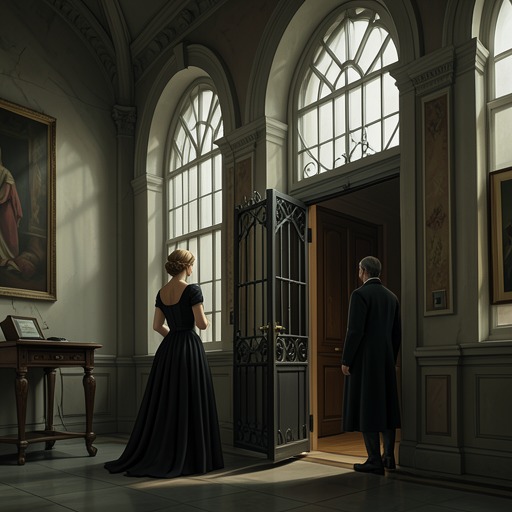
The ball takes place on a wooden dance floor in a palace lit only by moonlight. Its scale and ornament enforce the ceremony’s grandeur: the ballroom is described as the size of a football field, lined with tall mirrored panels and gold statues holding burning candles, with crystal chandeliers beneath a domed ceiling and vivid frescos depicting figures from Greek mythology. The eighteenth-century visual style of the dresses, embroidered tailcoats, and waistcoats makes the setting feel simultaneously historical and artificial, an effect intensified by the fact that it exists in an underground city of the future.
During the dance, Byron continues guiding Clara around the floor while she absorbs the discovery that she may be the lost Empress’s child. She understands that she could have been stolen and hidden in 1987, centuries before Londinium existed, and that the family history she accepted may have been manufactured. The revelation makes her question whether her mother was truly her mother and whether she was ever James Driscoll’s child. Her conclusion that her life has been built on lies turns the ball’s polished ceremony into a crisis of memory and belonging.
Clara’s reaction is bodily as well as intellectual. Her mind races through what she had believed were memories, she feels sick, and angry, wounded tears fill her eyes despite her determination not to cry in public. When she asks Byron to release her, her distress is made more conspicuous by the courtly setting and by the surrounding ladies and men who can see her struggle. The ball therefore functions as a threshold: Clara has entered the palace as a socially uncertain young woman, but the revelation places her within the history of the lost Empress and the succession politics of the Taleians.
Byron Phraeon’s Public Claim
Byron refuses to treat Clara’s distress as a reason to end the dance. He pulls her sharply back when she tries to withdraw, holds her tighter, and tells her that the past has happened and that the future must be faced. His reassurance is inseparable from possession. He presses a hand against her back, kisses her cheek, and declares that her future is with him, using intimacy as a public mark of ownership rather than as a private exchange.
Clara immediately interprets the kiss as a deliberate signal because Darius, Prince Octavius, and Carter are watching. Byron knows that he has an audience, and his triumphant smile confirms that the gesture is meant to be seen. Octavius appears hurt, Darius narrows his eyes at Byron, and Carter turns away when Clara looks toward him. Even Raine watches Clara closely. The kiss thus transforms the dance into a contest conducted through witnesses, with Clara’s body made to carry a political message she has not authorized.
Clara rejects that message aloud, warning Byron not to repeat the act and insisting that she does not belong to him as property. Byron answers that she does belong to him and predicts that he will soon make her his bride. He acknowledges that Prince Octavius and the Lord Protector will fight for her hand, but presents their rivalry as a contest he expects to win. His language turns courtship into acquisition and anticipates a struggle in which Clara’s own wishes are repeatedly displaced by male claims.
When the music ends, Byron finally releases her only to clap for the orchestra with a mocking, satisfied grin. Clara experiences the scene as grotesquely theatrical, comparing herself to Alice in Wonderland and Cinderella as she tries not to flee. He catches her gloved hand before she can leave, kisses it, and promises to keep watch over her until he can make her his. The formal ending of the dance therefore does not restore Clara’s freedom; it extends Byron’s claim beyond the floor and into the future.
Taleian History and the Bonding System
After Clara leaves the dance floor, Louise Turner comes to her aid while Byron and Darius remain engaged in an argument. Louise asks whether Clara is all right and suggests that they find somewhere private to talk. This movement away from the public spectacle opens the explanatory portion of the event, in which Prince Octavius supplies the history that gives the men’s behavior its larger context.
Octavius explains that the Taleians and the Druids were two races living in ancient Briton before the Roman invasion. The Taleians were divided into clans and governed by a Queen from the first Royal Clan, Morrigan, whose consort was a Knight of Swords taken from the Breannin Clan, the second royal clan that also included her knights. Taleian men were renowned warriors with exceptional strength and sword skills, while Taleian women possessed extraordinary psychic gifts. The account recasts Clara’s possible ancestry as part of an organized royal and martial tradition rather than as an isolated secret.
He also describes the Book of Talus, a magical book that chooses a Taleian’s mate. At a child’s birth, the child’s name appears in the book beside the name of a designated fated mate, although no one knows how the selection occurs. The ball’s romantic competition is therefore connected to a hereditary system that claims to determine intimacy before personal choice becomes possible. Clara’s royal identity and the Book of Talus together make her desirable to the court in ways that exceed ordinary attraction.
Octavius further explains that the Druids, jealous of the Taleian Queen and her handsome warrior consort, devised a curse. The curse transformed the Taleians into vampires, provoking bloodlust and turning them against one another. Pursued by the Druids and other humans, the Taleians were driven from their lands and scattered across the world in separate clans. The history Clara hears is shocking because it contradicts the familiar image of the Druids as nature-loving figures or practitioners of human sacrifice, yet Londinium’s own impossibility makes the hidden version credible.
The bonding system is not limited to the Book of Talus. Octavius states that several duels must be fought before two fated mates can be joined by blood. The duels establish a psychic bond through which the partners’ thoughts flow as one; only before the final union does the male bite the female. The explanation gives a ritual and legal structure to the claims being made around Clara, but it also clarifies why those claims are dangerous: courtship is backed by combat, psychic penetration, blood, and a prescribed gendered act of marking.
Rival Claims and Clara’s Resistance
The ball gathers several possible claimants around Clara without giving her control over the terms of the competition. Byron publicly names her as his future bride. Octavius later says that he felt a pull toward her from the moment he saw her and that his consciousness has already reached the outskirts of her mind. He believes it is only a matter of time before he breaches her mind and establishes the bond.
Octavius also senses Darius at the edge of Clara’s mind and recognizes him as a rival. He warns Clara that she is his property and says he will fight to the death to win her and rule her. His claim is followed by a forceful kiss that leaves Clara feeling helpless and divided between wanting to surrender to Octavius and wanting Darius. The scene makes desire and coercion deliberately unstable: Clara experiences attraction, but the surrounding claims, physical control, and supernatural influence prevent attraction from functioning as uncomplicated consent.
Clara’s thoughts expand the conflict beyond a simple choice between suitors. She remembers that the last Empress had five consorts and wonders whether Darius and Octavius might become two of them, even as she recognizes the situation as insane and asks herself what she is doing by allowing the men to take control of her. She also recalls that Carter, Byron, and Darius have each wanted something from her, while Octavius is the son of the Emperor, a ruler who would have her killed if he knew her true identity. Her uncertainty is therefore emotional, dynastic, and physical at once.
Her refusal to remain inside that script is decisive. After Octavius’s kiss, she pulls away, breathing hard, and says she cannot continue. When the Prince begins pacing and hissing at Darius, he demands that Clara be released and insists that she belongs to him. Darius answers that the rules must be followed and that Octavius is frightening Clara, urging her to calm herself and addressing her as a highness. Carter approaches but remains at a distance when Clara signals him to stay back, because she does not want him injured. His calm offer to come and get her provides a counterpoint to the possessive language surrounding her.
Consequences and Narrative Significance
The immediate consequence of the ball is that Clara can no longer regard her life, her family, or her arrival in Londinium as separate mysteries. The public dance links the revelation of her royal blood to the Taleian history of clans, curses, vampire inheritance, psychic gifts, and fated mating. Her hidden past is not merely information about where she came from; it changes the rules by which others claim the right to decide her future.
The event also converts private attraction into visible political conflict. Byron’s cheek kiss is staged before the court, Octavius responds as a wounded rival, Darius’s anger threatens violence, and Louise and Clara leave the dance floor while the men continue arguing. The ballroom’s mirrors, statues, chandeliers, and watching crowd turn intimacy into spectacle. Clara’s tears become part of that spectacle, while the men repeatedly interpret her status through ownership, marriage, protection, or ritual law.
As a ritual threshold, the ball separates Clara from the ordinary identity she brought from 1987 without yet reintegrating her into the royal order of Londinium. She learns the history that explains the court’s behavior, but she does not accept the authority of that history over her body. The event ends not with a completed bond or settled marriage, but with her withdrawal, the rivals’ unresolved confrontation, and the continuing threat that one of them may attempt to convert a supernatural claim into possession. Its decisive significance lies in that unresolved tension: the palace ball announces Clara’s inheritance while making her resistance to inherited rules equally central.